
Life after the buy: what happens to a stock when it enters the portfolio?
Choosing the right positions is obviously important, but the initial buy doesn't determine the investment outcome.
Stock selection identifies the opportunity. Subsequent portfolio management can shape how much value is captured.
Here, we explore what happens after the initial buy decision and how a manager’s subsequent decisions can amplify, moderate or even reverse the outcome.
Main takeaways
Selection has a strong pull: post-entry management usually reinforces the direction established by the original stock selection
Outcomes can reverse: approximately one-in-six portfolios see positive
outcomes turn negative and negative become positive
Negative starts aren’t fatal: more than one-in-four negative starting outcomes were repaired enough to become positive.
Management shares capture: what happens after a position is established influences how much of the original opportunity is captured.

Selection and capture
Selection and capture are two distinct parts of the investment process that both play important roles in investment performance.
Stock selection determines which opportunities enter the portfolio; subsequent position management shapes how much of that potential value is captured.
Managers decide how much capital to commit, the most suitable portfolio weighting, and whether to increase or reduce exposure.
We wanted to understand the impact of post-entry management to identify how often it influenced the eventual portfolio outcome.
Research and analysis
Using SkillMetrics® data, we compared 134 actual portfolios with a simplified version of the same strategy to isolate the effect of portfolio management.
The simplified portfolio held the manager’s stock selections at a representative established weight until the exit date. We intentionally kept this date the same.
The aim wasn’t to assess the manager's exit skill, but to understand what happened to the opportunity while it remained in the portfolio.
Impact of post-entry management
It was also important to look for evidence of the three distinct outcomes that can materialise from post-buy management:
Reinforcement: is when the management pushes the result further in the direction established by its initial selection.
Repair/dilution: is when the management moves against the direction but doesn’t reverse it altogether.
Reversal: occurs when the management is strong enough to completely change the outcome, either positively or negatively.
Our findings
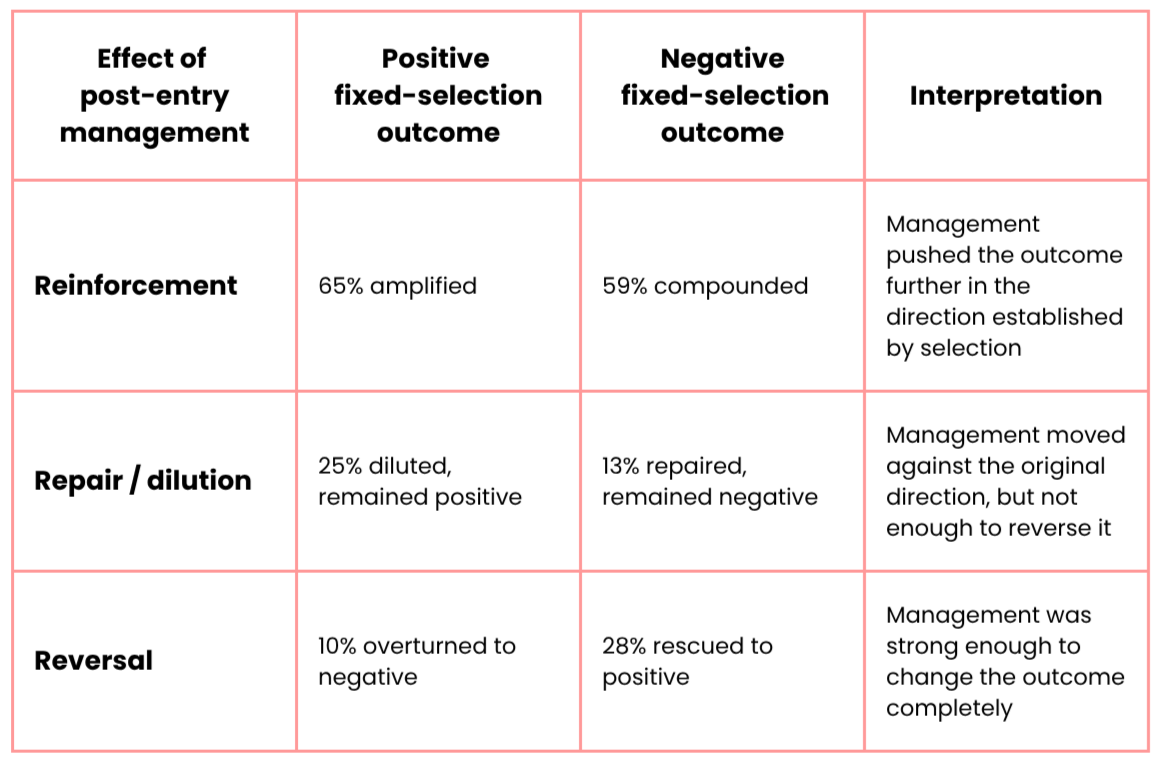
In 65% of portfolios with positive fixed-selection outcomes, management amplified results. In 25% of cases, they diluted them, and in 10% they were overturned.
Among portfolios with negative fixed-selection outcomes, 59% compounded results, 13% were partially repaired, and 28% were fully rescued.
In one in six portfolios, position management reversed the outcome, turning a positive result into a negative, or vice versa.
Where it added value, the contribution relative to the static strategy was around +2.4% a year. Where it reduced value, the effect averaged around -2.0% a year.
What does this tell us?
Selection has a strong pull on what follows
First, initial stock selection matters. Subsequent management tends to work with the direction established by the original selection, rather than against it.
In two-thirds of positive starting outcome , ongoing decisions amplified the result. In negative starting outcomes, most were compounded, rather than repaired.
The implication is that the initial selection does more than create an opportunity; it establishes a trajectory that subsequent position management frequently reinforces.
But the starting trajectory is not destiny
However, the starting trajectory doesn’t always dictate the final outcome.
A meaningful share of negative starting outcomes were improved, while more than one in four were repaired enough to become positive.
Across the full sample, roughly one in six portfolios had its outcome reversed completely by subsequent position management.
So while selection establishes a strong starting trajectory, what happens afterwards can still moderate, repair or potentially change the destination completely.
Conclusion
Stock selection remains fundamental in creating an initial trajectory that can influence subsequent investment returns.
The challenge after the buy is not simply whether to trade.
It is how strongly to continue expressing the thesis, how long to give it room to work, and when the evidence is strong enough to change course.
About:
SkillMetrics® helps managers and allocators understand the decisions behind investment performance across the full lifecycle of a position, from selection and conviction through scaling, trimming and exit.
By making those decision patterns observable, SkillMetrics® shows not only what happens after a stock enters the portfolio, but where behavioural strengths, recurring tendencies and sources of value or drag sit across the wider investment process.
If you would like to explore what this kind of behavioural analysis could reveal about a portfolio, manager or investment process, we would be pleased to discuss.