
Conviction allows investment managers to commit meaningful capital to their strongest ideas. But what happens if those positions disappoint?
Does maintaining conviction make it harder to reconsider a holding, or can managers adjust the amount invested while retaining the investment thesis?
In this special report, we investigate the relationship between conviction and adaptability – and whether they can co-exist.
Main takeaways
Conviction under pressure: managers rarely abandon high-conviction positions following performance deterioration.
Reinforcing conviction: increasing exposure after deterioration can be productive; scale up decisions generated positive outcomes in 51.3% of cases.
Managing the downside: Scale Down decisions’ stronger Win/Loss Ratios suggest managers focus less on picking winners and more on controlling losses.
Adapting without abandoning: most scale down decisions still left positions as high conviction; reducing exposure doesn’t mean giving up on the thesis.

The importance of conviction
Conviction is essential for fund managers. It influences which ideas are worth pursuing and dictates their subsequent portfolio weighting.
Favoured names are given prominent positions and expected to withstand short-term volatility on their way to (hopefully) delivering decent returns.
In our previous research, Investing with conviction, we found that high conviction positions contributed positively to performance in 80% of the portfolios analysed.
By contrast, lower conviction positions were far less successful and often dragged on performance. Making the right calls is therefore crucial.
The stubbornness dilemma
Unfortunately, strong conviction has a potential downside: the risk of remaining fully invested despite mounting evidence to the contrary.
The reality is there’s a very fine line between investment discipline and stubbornness. Holding firm can demonstrate confidence; blind faith may damage the portfolio.
Being totally committed to a position can encourage managers to ignore reality and not reconsider their stance when circumstances change.
So what is the most appropriate response? We wanted to understand how they reacted when their strongest convictions came under pressure.
Reaction to deterioration
We looked at investment decisions in almost 250 portfolios, focusing on positions seen as high conviction before their portfolio contributions deteriorated significantly.
But rather than assuming such a downturn should automatically trigger a sale, we examined the subsequent decisions managers made.
Our research found they rarely abandoned their highest conviction positions. In fact, full exits accounted for just 8.3% of subsequent actions. However, managers weren’t inactive either.

They continued to adjust their exposure, sometimes increasing positions (scaling up) and sometimes reducing them (scaling down).
Our next task was seeing whether these approaches actually delivered value.
Impact of resizing
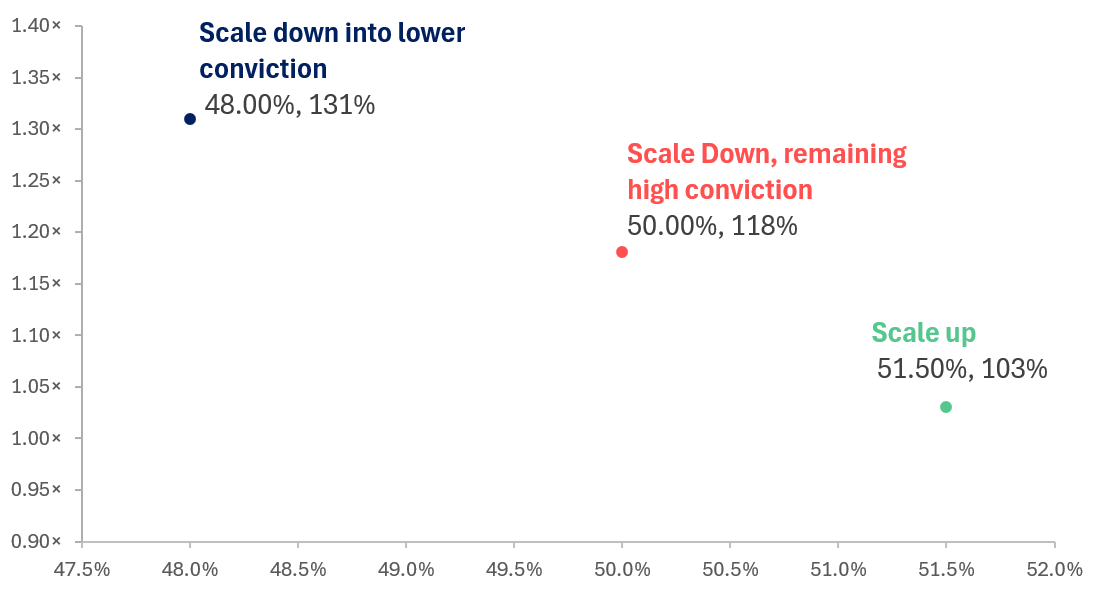
Scale up decisions achieved the highest success rate, with positive contributions in 51.3% of cases. Their win/loss ratio, however, was relatively modest at 1.03.
Scale down decisions exhibited a different profile. Although their success rates were slightly lower, their win/loss ratios were stronger, reaching 1.31 when the position was reduced to a lower conviction category.
Importantly, all three groups – scale up, scale down and scale down to a lower conviction – generated positive aggregate contributions over the subsequent decision period.
What does this tell us?
The research showed that both scaling up and scaling down can be the right call, depending on the circumstances.
Increasing exposure to a disappointing position may reflect a manager’s willingness to reinforce an investment they continue to believe in. Reducing exposure, meanwhile, lets them remain invested while moderating the capital committed until the situatin changes.
The outcomes we found are consistent with these decisions playing different roles in a manager’s overall portfolio.
Scaling up is associated with more frequent positive outcomes; scaling down appears more focused on limiting losses while preserving gains.
Of course, this doesn’t mean every adjustment was correct, or that one approach is superior, but it challenges the assumption that continued commitment to a deteriorating position is a negative.
Adapting…without changing direction
Having conviction in an investment and adjusting how much money you commit to the position can co-exist. A manager may continue to believe in a company's prospects while recognising that the amount of capital committed should change.
The overall investment thesis and the appropriate position size are related, but they are not indelibly linked.
In fact, when managers reduced their high-conviction positions, 82% of those positions remained high conviction. Managers reduced exposure without necessarily abandoning their original conviction level.
That’s a crucial distinction: reducing a holding doesn’t necessarily reflect lost confidence. It may simply be a way to manage risk while retaining exposure. In fact, reducing a position can actually represent a refinement of conviction rather than its complete abandonment.
Equally, increasing exposure after deterioration is not always evidence of stubbornness. If the manager believes that the expected reward has improved relative to the risks, adding capital may be entirely consistent with disciplined investment management.
Our findings suggest that both approaches can continue to generate value, although through different payoff characteristics.
Conclusion
Conviction and adaptability aren’t mutually exclusive.
Our research showed that managers rarely abandon their strongest convictions when they run into trouble, but are willing to change their exposure. Most continue to make investment tweaks, adjusting their exposure while preserving their commitment to high conviction positions.
So, what does this imply?
Conviction should not be judged simply by a manager’s willingness to hold on; nor adaptability by the frequency of trading
What matters is whether the decisions made while maintaining conviction continue to generate value.
About:
SkillMetrics® helps managers and allocators understand the decisions behind investment performance across the full lifecycle of a position, from selection and conviction through scaling, trimming and exit.
By making those decision patterns observable, SkillMetrics® shows not only what happens after a stock enters the portfolio, but where behavioural strengths, recurring tendencies and sources of value or drag sit across the wider investment process.
If you would like to explore what this kind of behavioural analysis could reveal about a portfolio, manager or investment process, we would be pleased to discuss.